

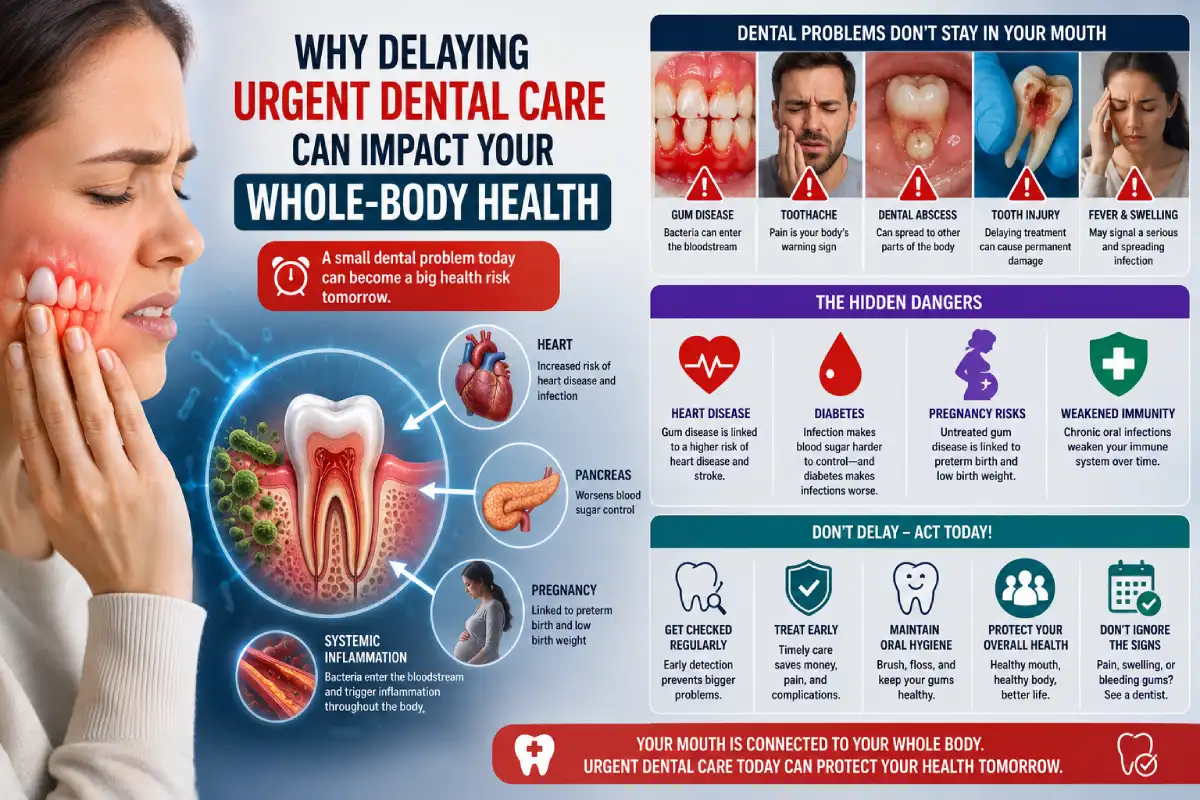
A painful tooth is never simply a dental issue. When bacteria invade the gums, they can easily enter the bloodstream and spread to the heart, pancreas, or in pregnant women, to a developing fetus. Ignoring a toothache isn’t prudence. It’s a risk to organs that are far removed from your teeth.
Table of Contents
Your mouth is not a closed system
Teeth may seem distinct from the body, more like physical features rather than organic. But in reality, they’re not. Gum tissue is thin, rich in blood vessels, and regularly exposed to the bacteria present in your mouth. If your gums are healthy, this is not a problem. However, if they’re swollen or infected, bacteria easily enter the bloodstream when you chew, brush, or floss.
One bacterium repeatedly appears in studies related to this issue: Porphyromonas gingivalis or P. gingivalis, a key factor in periodontal disease. Once this bacterium spreads, your body reacts similarly to how it reacts to any threat, by triggering inflammation. This inflammation spreads as your body raises C-reactive protein levels, a common indicator used by doctors to monitor cardiovascular health. Hence, a gum infection you’ve been neglecting leaks proof of inflammation into your entire bloodstream.
The heart connection is not theoretical
Heart disease is the most extensively studied consequence of untreated gum disease, and the evidence certainly suggests that the link is a strong one. In fact, gum disease is considered an independent risk factor for cardiovascular disease, and the increased risk can be as much as double that of people with healthy gums in some studies. The prevalence of this association has even encouraged cardiologists to begin inquiring about gum health at routine appointments.
Then there’s the more sudden, less common but far more alarming complication: infective endocarditis. This is a potentially life-threatening infection of the inner lining or the valves of the heart, and oral bacteria have been identified as one of the culprits. While infective endocarditis is rare, it is taken so seriously that patients with certain heart conditions are given prophylactic antibiotics before dental treatment to prevent it. The point is not that every oral abscess leads to a bacterial infection of the heart. The point is that the oral pathogen-heart connection has been well-established in the dental literature. It’s not just hype.
Diabetes and gum disease feed each other
If you manage type 2 diabetes, your gums are more important than you may realize – you should probably be paying more attention to them. The relationship between periodontal disease and blood sugar control is a two-way street. High blood sugar makes oral bacteria more likely to grow, exacerbating gum infections. That infection causes systemic inflammation, which makes it harder for your body to properly regulate insulin. And around it goes.
The feedback loop can be broken. And, in fact, research shows that taking steps to address periodontal disease can lead to a real, measurable decrease in levels of hemoglobin A1c, which is the standard measure of long-term blood sugar levels. For patients struggling to manage diabetes, getting treatment for a gum infection may be the one change that makes a difference at their next physical. Dental treatment starts to be part of managing diabetes, rather than a separate task.
What actually counts as a dental emergency
Not every ache or pain requires a same-day checkup. It’s a reality that some problems just aren’t urgent. But there are a few symptoms that really do mean you’re on the clock, and every hour of unnecessary delay piles risk on top of what is probably already going to be a painful problem to solve.
A dental abscess is a pocket of pus caused by bacterial infection, they’re also the sort of “wait and see” issue you don’t want to wait or see how it turns out. Waiting doesn’t cure a bacterial infection, and neither do home remedies. An abscess must be drained by a dentist and the infection treated professionally, or it will spread. It may spread into the natural spaces in the face, which can be a surprisingly serious medical emergency, even if the source is a tooth. If it moves into the bloodstream and triggers a systemic immune response, that’s sepsis, and people can literally die waiting to see if that turns into a hospitalization.
Facial swelling should always be a “go now” symptom, but if it’s accompanied by fever and a toothache or by difficulty swallowing or breathing, then speed is of the essence. Those are dangerous symptoms of a spreading infection, and these conditions can land people in the hospital having life support administered within a day if they delay.
Trauma is a separate category by itself, and the clock runs a lot faster than you think. An avulsed tooth has its best chance of successful re-implantation if it goes back into its socket within 30 to 60 minutes, and we’re not kidding around: that’s the difference between keeping a tooth your whole life and losing it. A cracked tooth that is sealed in the same day can often avoid a root canal entirely, while the same crack left open for a few months will almost always require one. It is a matter of hours, not weeks, and not everyone understands that at first.
If you’re dealing with swelling, an abscess, a knocked-out or badly cracked tooth, or pain bad enough to wreck your day, anyone searching for an emergency dentist in St. Louis is usually already past the point where home remedies make sense, and getting professional care quickly is what actually limits both the medical risk and the eventual cost of treatment.
Pregnancy raises the stakes further
Pregnant women may think that they should delay dental treatment until after birth, for safety’s sake or due to faulty assurances that it’s not safe. In fact, the heightened risks of preterm birth and low birth weight come from active periodontal infection going untreated, not from same-day dental work. Postponing urgent dental treatment isn’t a neutral strategy – the infection is a real threat to the pregnancy.
Urgent or same-day dental treatment for a pregnant patient needs to be provided by a dentist able to adjust the usual care as appropriate. However, the potential harm to the pregnancy that may come from a local anesthetic, pain meds, or X-ray is dwarfed by the danger of a spreading bacterial infection, including the kinds of inflammation that promote preterm birth. Your body senses that inflammation and its chemicals reach the placenta.
The cost of waiting compounds fast
Ignoring dental issues doesn’t make them disappear. They worsen over time, and the treatment becomes more expensive.
For instance, a small cavity can be easily treated with a filling. But if you procrastinate, the decay will reach the tooth’s pulp, and you will need a root canal treatment and a crown. If you delay further, the tooth may be damaged beyond repair, leading to an extraction, implant, or bridge – the most expensive option. Similarly, bleeding gums or persistent bad breath is likely caused by gingivitis, which can progress to periodontitis, irreversibly damaging the jawbone that supports your teeth.
So, don’t postpone dental treatment thinking the problem will go away on its own. It will simply escalate, costing you more money and time in the long run.
Pain itself is a whole-body problem
Before an infection has a chance to spread anywhere, the pain from a dental emergency is causing harm. Chronic tooth pain causes sleep disturbances, and lack of sleep raises cortisol levels. Increased cortisol has been associated with poorer blood pressure management and exacerbates bruxism, the unconscious clenching and grinding of teeth people frequently do at night, which adds more stress on already-strained teeth. It’s a feedback loop that starts before any bacteria enter your bloodstream – you’re just in pain and sleeping poorly.
This is worth sitting with for a second, because it reframes the whole conversation. Your tooth does not yet have to be infected for your heart rate, blood pressure, and stress hormones to be affected by a dental issue.
What to do with this information
None of this is meant to turn a sore tooth into a five-alarm crisis every time. Most minor sensitivity or mild discomfort can wait for a regular appointment. But the line between “this can wait” and “this needs attention now” is clearer than most people treat it. Swelling, fever, abscess, trauma, or pain that’s getting worse rather than better are signals your body is already dealing with something systemic, not just local.
Take gum bleeding seriously before it becomes bone loss. Take a cracked tooth seriously before it becomes a root canal. Take a toothache during pregnancy seriously rather than assuming it’s safer to wait. The mouth was never separate from the rest of the body, and the evidence connecting oral infection to heart disease, diabetes complications, and pregnancy outcomes has made that connection impossible to treat as minor. Acting early is cheaper, safer, and a lot less painful than finding out the hard way what happens when a small problem is given months to become a big one.