

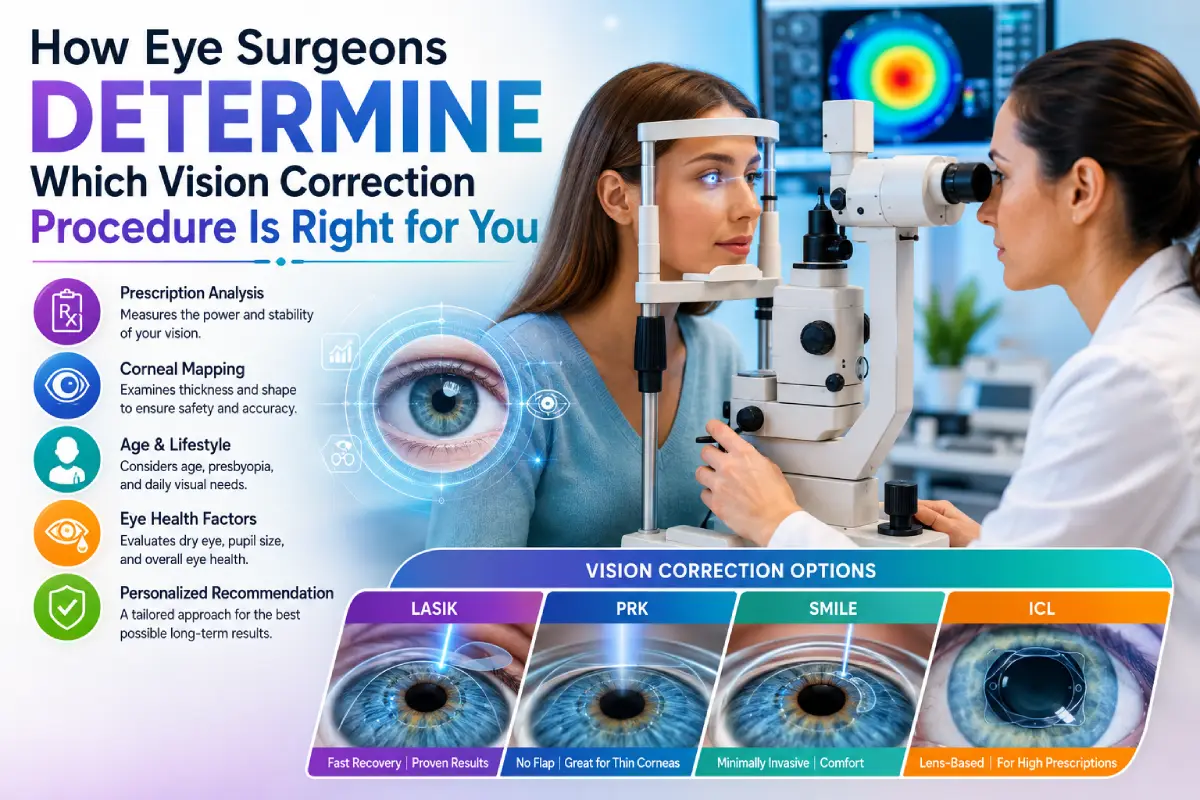
Usually, individuals arrive for a vision adjustment evaluation having in mind that they will be offered LASIK. Nonetheless, a good surgeon will provide them with insights likely to be more of an analysis. The decision for a procedure made at the conclusion of an evaluation isn’t random, but rather dependent on a set of clinical dispositions. Once you understand them, your view on the whole thing will shift.
Table of Contents
The Prescription Is The Starting Point, Not The Answer
Each assessment begins with your refractive error. The sphere value indicates to the doctor how much near- or farsightedness they must correct. Meanwhile, the cylinder and axis values determine the astigmatism part. Combined, these numbers identify the optical issue and rule out most treatment options straight away.
For instance, a high prescription requires the removal of more corneal tissue during a laser surgery. Should that be extensive enough, a laser method will not be able to preserve enough tissue to support the structure of the eye – and a lens surgery is the better option. For anyone understanding more about eye prescriptions for the first time, the sphere and cylinder numbers may seem abstract, but, for a doctor, they represent the first guidelines to follow in patient treatment.
Another factor that determines treatment at this early stage is the scenario of your prescription stability. Normally, the doctor will not agree to treat a refractive error that continues to develop. While each clinic may have specific rules, most will opt for the general guideline of no significant change for a minimum of 12 months. A constantly changing prescription makes the results unreliable. So, if it turns out that your prescription has recently been on the move, the only answer is to hold off.
Corneal Mapping Is Where Candidacy Gets Decided
With the prescription in hand, the surgeon turns their attention to the cornea. Here, two tests play principal roles: pachymetry measures the thickness of the cornea at various points, and corneal topography maps its surface shape.
These tests are not just formalities; they’re the gatekeepers.
A cornea that is too thin cannot undergo the ablation necessary for laser correction. A cornea with irregular contours, particularly one indicating early signs of keratoconus (a thinning condition that worsens over time), rules out laser procedures entirely. Such patients are not poor candidates for LASIK; they are contraindicated. Performing a laser procedure on that cornea can worsen the condition, which is already prone to be unstable. For these patients, an implantable collamer lens (ICL) is often the appropriate choice as it does not alter the cornea but leaves the natural cornea optics in place and stabilizes vision.
Topography also affects the choice between LASIK, PRK, and SMILE. PRK is safer in patients with low corneal thickness and may be needed if there is mild surface irregularity because in such cases it is safer to remove some or all of the surface epithelium and then apply the laser. SMILE makes sense if the cornea is of normal thickness or a bit thin and the incision is made internally without opening any external surface. You cannot decide on the procedure by the thickness number alone, however, because of the relationship that exists between it and what an elevation simulation shows regarding the corneal surface. Postoperative results often differ if this relationship between thickness number and surface topography is ignored on the basis of software analysis alone.
Age Changes The Options On The Table
A 28-year-old myope and a 52-year-old myope with identical prescriptions won’t necessarily receive the same recommendation. Age is an independent variable in this decision.
Presbyopia – the gradual loss of near-focus flexibility that typically begins in the mid-40s – means that correcting distance vision with a laser procedure may leave the patient fully dependent on reading glasses afterward. That’s not a surgical failure; it’s a predictable optical outcome. But it changes the risk-benefit conversation significantly.
For patients over 40, surgeons often raise monovision as a strategy: correcting one eye for distance and allowing the other to remain slightly myopic for near work. The brain adapts to use each eye for its strength. Not everyone tolerates it, and a trial with contact lenses before committing to surgery is the standard way to test it. Some older patients are better served by lens-based procedures altogether, where the natural lens is replaced with a multifocal or extended-depth-of-focus implant.
Dry Eye And Pupil Size Aren’t Minor Considerations
In popular science, particularly marketing material, two factors are often overlooked when it comes to laser eye surgery and performance.
These are tear film health and pupil size.
Dry eye is a common problem, and laser eye surgery can exacerbate it – generally for a few months, but in some cases long-term. Surgeons will test the quality and production of your tears before your operation and it’s possible that severe dry eye might disqualify you from LASIK, the treatment that’s most likely to have been advertised to you.
This will be more likely if your specialist thinks that your dry eye problems are likely to prevent you from healing correctly after LASIK.
During your check-up, your specialist will also probably check the size of your pupils in low light. This is because large pupils can expose you to another side-effect of treatment: glare, haloes, and starbursts around lights at night, which are thought to be caused by the untreated, curved edge of your cornea coming into view and diffracting light across your retina.
These problems are much less likely with modern laser technology – especially wavefront-optimized laser technology, which aims to explicitly expand the area of treatment for people with large pupils and those with fine detail in their pupils.
Your surgeon would probably still prefer a different kind of surgery if you have large pupils and are a night-time driver, though, and anyone with experience of performing the operation would probably advise against LASIK and wavefront-lasik if you spend a lot of time in seriously low light levels – e.g. a photographer in a darkroom.
The Recommendation Is A Match, Not A Menu Selection
The purpose of a pre-operative assessment is not to order all the available tests to oversell a procedure. This evaluation is meant to gather the necessary information to offer the best advice and optimize the surgical outcomes that correspond to patients’ expectations and needs. Whether we are talking about medical, emotional, or age and lifestyle considerations, there is no single answer as to which procedure is the best for you. It will always depend on your specific situation.