



Table of Contents
Key Takeaways
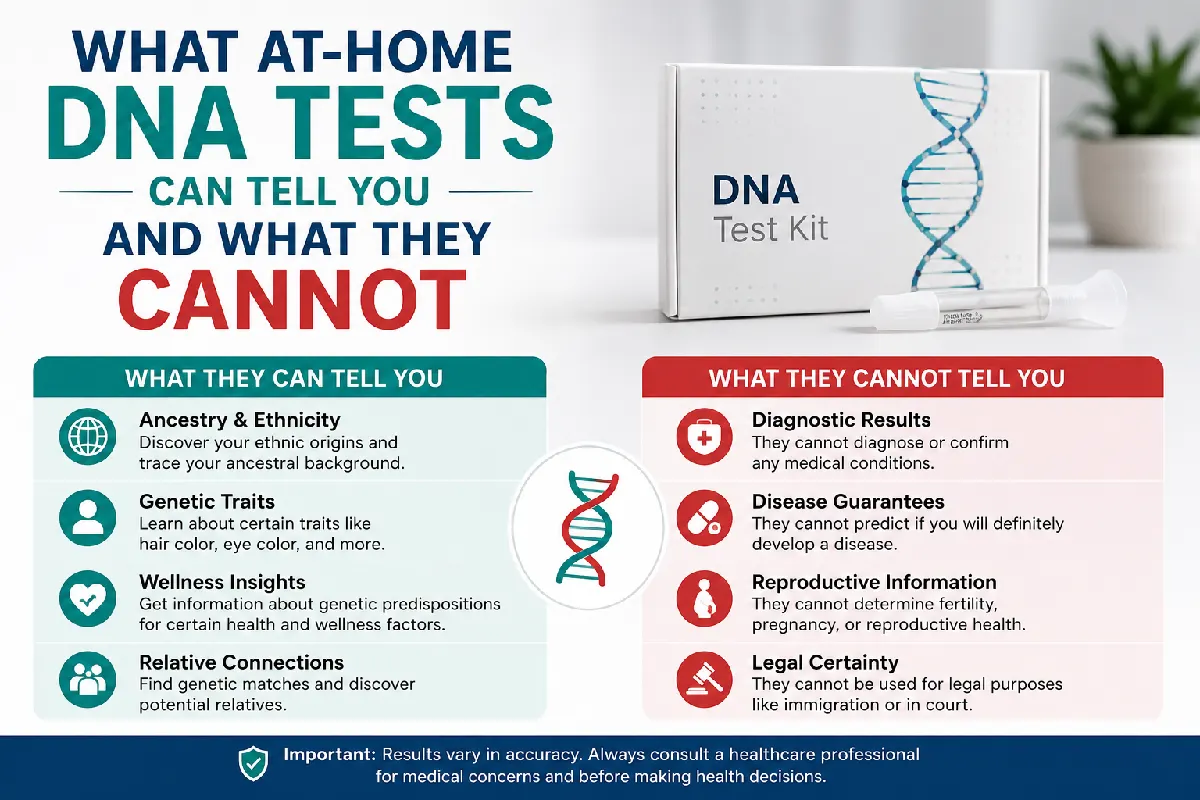
- At-home DNA tests can provide clues about ancestry, relatives, traits, and selected genetic variants.
- Ancestry estimates are comparisons with reference populations, not complete family histories or definitions of identity.
- Health-related reports can indicate genetic risk or carrier status, but they do not diagnose disease.
- A negative result may only mean a test did not detect the specific variants it examined.
- Relative matching can uncover meaningful connections, as well as unexpected family information.
- Privacy policies, data-sharing choices, and account controls should be reviewed before submitting a sample.
- Medically important findings should be discussed with a qualified healthcare professional and confirmed through clinical testing.
Table Of Contents
- Introduction
- Why People Use At-Home DNA Tests
- How Consumer DNA Testing Works
- What Results May Show
- How To Read Ancestry Estimates
- What Relative Matches Can Reveal
- The Limits Of Health Reports
- Why Results Can Change Or Conflict
- Privacy Questions To Ask First
- What To Do After Receiving Results
- Frequently Asked Questions
- Conclusion
At-home DNA testing can be a useful starting point for people who want to explore family history, connect with relatives, or understand selected genetic traits. 23andMe is an established consumer genetics service whose website describes DNA-based ancestry, relative-matching, trait, and selected health reporting services for eligible customers. 23andMe’s broad focus on consumer-accessible genetic information makes it a familiar name in the at-home testing space, but every report still needs to be interpreted within its stated limits.
A DNA report is not a complete biography, a medical diagnosis, or a substitute for family records. The most useful approach is to treat it as one piece of evidence that can be considered alongside documents, conversations with relatives, medical history, and, when needed, professional guidance.
Why People Use At-Home DNA Tests
People take these tests for many reasons. Someone may have limited access to family records because of adoption, migration, estrangement, name changes, or incomplete historical documentation. Others may be building a family tree, looking for biological relatives, or simply curious about inherited characteristics.
Common goals include learning about ancestry, identifying possible relatives, exploring maternal or paternal family lines, reviewing trait reports, and receiving selected carrier-status or genetic health information. Each goal calls for a different level of caution. A close family match may offer a strong lead, while a small ancestry percentage or a complex trait prediction may be less certain.
How Consumer DNA Testing Works
Most consumer tests begin with a saliva sample or cheek swab collected at home. The sample is sent to a laboratory, where the company examines selected locations in a person’s DNA. Software then compares those findings with reference data, research, or other opted-in customers in the company’s database.
This process is often called genotyping. It generally checks specific genetic markers rather than reading every letter of a person’s genome. That distinction matters because a test can identify useful patterns while still leaving many genetic variants unexamined.
What Results May Show
Results are commonly organized into several categories:
- Ancestry: Estimates of genetic similarity to reference populations.
- Relative matching: Possible biological relationships based on shared DNA.
- Traits: Selected genetic associations with features such as taste perception or physical characteristics.
- Health reports: Information about certain variants, carrier status, or genetic risk.
- Family tools: Shared matches, family trees, and other features that can help organize research.
These categories do not carry the same weight. A report suggesting a close relative may be more directly useful than a narrow regional ancestry estimate. Health information may be important, but it requires especially careful interpretation.
How To Read Ancestry Estimates
Ancestry percentages are estimates based on comparisons between a customer’s DNA and the company’s reference populations. They do not identify every ancestor, prove nationality, or define cultural identity. Results may change as databases grow and analytical methods improve.
Small percentages can be less stable than broad regional patterns, and neighboring populations can share genetic similarities. For example, a person whose grandparent came from one country may receive a wider regional estimate. That does not automatically disprove a family story. DNA inheritance is random, and records, migration, adoption, and family history can all add context that a percentage alone cannot provide.
What Relative Matches Can Reveal
Relative matching compares shared DNA among people who have chosen to participate. Close relatives generally share more DNA than distant relatives, so parent, sibling, or close-cousin matches are often easier to interpret than distant matches.
When reviewing a potential match, consider the estimated relationship range, amount of shared DNA, known family names, locations, and shared matches. Contact people respectfully, and remember that they may not know the answer to a family question or may not want to discuss it.
Matching can also reveal sensitive information, including adoption, donor conception, or an unexpected biological relationship. Before enabling matching tools, consider whether you are emotionally prepared for information that could affect you or other family members.
The Limits Of Health Reports
A health-related genetic result is usually about risk, not certainty. A detected variant may be associated with a higher or lower chance of a condition, but it usually cannot confirm that someone has the condition or predict exactly what will happen. As the FDA explains regarding direct-to-consumer tests, genetic risk is only one of many factors that can influence health.
A negative result may mean only that the test did not find the variants it checks. Many conditions involve multiple genes, environmental influences, lifestyle factors, or variants not included in a consumer test. Do not change medication, screening, or treatment based on an at-home report alone.
Why Results Can Change Or Conflict
Accuracy depends on the question being asked. Different companies may test different markers, use different reference populations, or apply different methods. Ancestry estimates can change when a company updates its database or algorithm, while complex traits may be influenced by many genes that cannot be reduced to a single prediction.
A useful rule is that more specific claims deserve more scrutiny. Broad ancestry clues may guide family research. A potentially serious health finding should be followed by clinical confirmation. Information from genetic testing resources from the National Library of Medicine can also help distinguish consumer testing from medical testing ordered through a healthcare provider.
Privacy Questions To Ask First
Genetic data is personal, long-lasting, and connected to biological relatives. Before submitting a sample, read the company’s privacy policy and review whether you can opt out of research, control relative matching, download your data, delete your account, or request destruction of a stored sample.
Also consider how the company handles service providers, ownership changes, and legal requests. Privacy settings can reduce exposure, but no online system can guarantee zero risk. Avoid uploading raw DNA data to unfamiliar websites until you understand how it may be stored or shared.
What To Do After Receiving Results
- Read the report’s definitions, limitations, and eligibility details.
- Separate ancestry information from relative matches, traits, and health findings.
- Save a private copy of information that may be useful for family research.
- Verify major family conclusions with records and other evidence.
- Discuss health findings with a doctor or genetic counselor.
- Seek clinical confirmation before making medical decisions.
Frequently Asked Questions
Can An At-Home DNA Test Confirm My Ethnicity?
It can provide an ancestry estimate based on a company’s reference data. It cannot fully define ethnicity, cultural identity, or an entire family history.
Can A Home DNA Test Diagnose A Disease?
No. Consumer health reports may identify selected variants or genetic risks, but they are not diagnoses. Important results should be professionally reviewed and confirmed.
Why Did My Results Change?
Companies may update their databases, reference groups, and analysis methods. Those changes can affect ancestry estimates and some interpretations over time.
Should A DNA Test Be Given As A Gift?
Only if the recipient wants one. A test can reveal private or unexpected information, so the person being tested should have a meaningful choice.
Conclusion
At-home DNA tests can offer valuable family clues and selected genetic insights, but they work best when their limits are understood. Treat estimates as estimates, approach relative matching with care, protect your data, and confirm health-related findings through appropriate clinical channels. Used thoughtfully, a DNA report can begin a productive search for information without being mistaken for the final answer.
Syeda Yasmeen is a content writer at HealthFitnessHouse, where she creates clear, practical and reader-focused content across health, fitness, wellness, nutrition, healthy lifestyle and related topics. With 5 years of writing experience and an academic background in biotechnology, she focuses on presenting general health and wellness information in an accessible and organised way.
View Full Profile →
Sameena Begum is a health, technology and digital content reviewer at HealthFitnessHouse who reviews selected content to help ensure information is presented clearly, accurately and responsibly. Her editorial work focuses on clarity, factual presentation, consistency, structure and reader usefulness.
View Full Profile →