

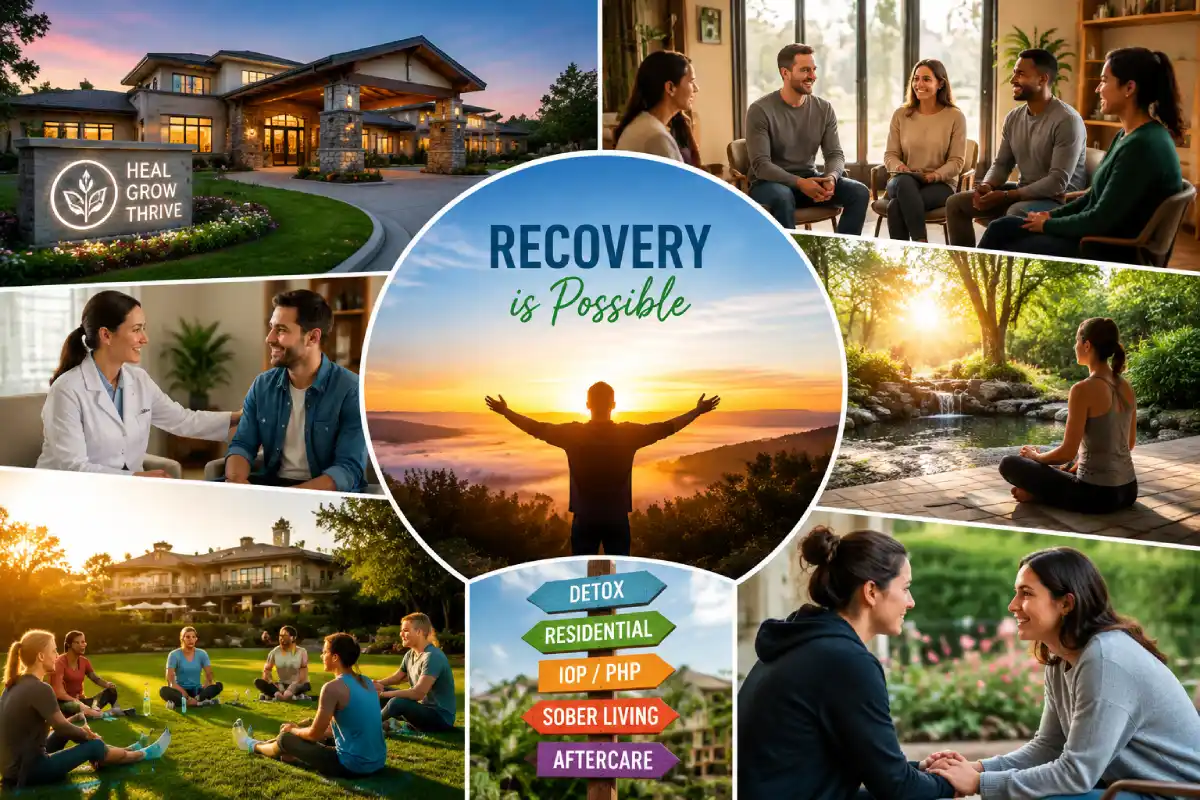
The single decision that shapes recovery isn’t just *whether* to get help – it’s *what level* of help you enter. Founded in 1954, the American Society of Addiction Medicine (ASAM) now represents thousands of specialists. It defines a continuum of care running from Level 0.5 (early intervention) through Level 1 (outpatient), Level 2 (intensive outpatient and partial hospitalization), Level 3 (residential and inpatient), up to Level 4 (medically managed intensive inpatient). Both ASAM and the Substance Abuse and Mental Health Services Administration (SAMHSA) view this framework as the clinical standard for matching patients to the right intensity of care. Start too low, and treatment can fail before it begins; start too high, and you risk burning through resources you might need later. That’s why we ranked these providers not by marketing hype, but by how effectively they cover that continuum for real substance use disorder treatment.
Our top pick is Legacy Healing Center for individuals and families who want a fully integrated, single-provider continuum. It covers everything from medical detox through inpatient residential, PHP, IOP, sober living, and aftercare, with dual diagnosis care built in. Crucially, step-down decisions are managed clinically in-house rather than handed off to a new provider. What really sets it apart is the depth of the clinical menu. Patients get access to evidence-based therapies like CBT, DBT, EMDR, Rapid Resolution Therapy, and Biofeedback/BrainPaint, alongside medication-assisted treatment (MAT) options such as Vivitrol and Naloxone – all within one upscale, structured setting. If your addiction is tightly bound up with mental health conditions like depression, trauma, or PTSD, Foundations Recovery Network is the strongest alternative. And for those with severe, long-standing, or high-acuity addiction histories who need intensive clinical oversight, Sierra Tucson is well worth a look.
Below are the seven best addiction treatment levels of care programs in the US for 2026, selected using the methodology described next. These entries span a range of specialties and geographies – from multi-state networks to the Southwest, California, and the Southeast – so you can weigh both clinical fit and travel distance.
Table of Contents
How We Ranked These
We approached this the way a clinician approaches ASAM placement: match the need to the capability, then judge quality honestly. We assessed every provider against the same five editorial standards, applying them consistently across all seven entries. First, continuum breadth – does the provider offer multiple connected levels of care (detox, residential, PHP, IOP, sober living, aftercare) under one roof or network, or just a single tier? Second, evidence-based clinical protocols – meaning validated therapies like CBT, DBT, EMDR, and MAT, rather than unproven approaches. Third, dual diagnosis capability – whether co-occurring mental health disorders are treated alongside addiction, not just bolted on as an afterthought. Fourth, accreditation and licensing – state licensure plus Joint Commission or CARF accreditation serve as objective quality markers. Fifth, MAT availability at the levels where it actually belongs.
These programs primarily serve adults seeking treatment for drug and alcohol abuse, along with the families researching on their behalf. As a broad overview of drug rehabilitation makes clear, no single model works for everyone. That’s exactly why we weighted continuum flexibility and clinical rigor so heavily. The ranking reflects overall continuum strength first, with each provider’s specialty noted so you can find the right fit.
The 7 Best Addiction Treatment Levels of Care Programs in the US
We chose these seven providers because each one shows what a high-quality, structured levels-of-care model looks like in practice – whether you need the full continuum from detox to aftercare or a single specialized tier. Every entry is measured against the five criteria above. Number one is our overall top recommendation, while the rest lead their own distinct segments.
Here’s the shortlist at a glance:
- Legacy Healing Center – best for a full-continuum, single-provider model with in-house step-down
- Pyramid Healthcare – best for multi-state continuum-of-care access
- Acadia Healthcare – best for integrated behavioral health networks
- Foundations Recovery Network – best for co-occurring addiction and mental health care
- Sierra Tucson – best for high-acuity residential treatment
- Cliffside Malibu – best for luxury residential rehab
- Elevate Addiction Services – best for holistic residential programs
#1. Legacy Healing Center – Best for Full-Continuum Single-Provider Addiction Treatment
If the biggest risk in recovery is falling through the cracks between programs, Legacy Healing Center is built to close that gap. It offers one of the most complete single-provider continuums you’ll find in the US. Patients have access to medical detox, inpatient residential, partial hospitalization (PHP), intensive outpatient (IOP), sober living homes, aftercare planning, and integrated dual diagnosis mental health services – all under one clinical roof.
You can explore the full range of tiers on the Legacy Healing levels-of-care hub, which maps exactly how each program connects to the next. That connection is the whole point. Instead of finishing detox and being handed a list of unaffiliated outpatient centers, patients step down through the levels while the same clinical team manages the transition. This preserves the therapeutic relationships and treatment continuity that fragmented care so often breaks.
Key features:
- Full continuum: medical detox → residential → PHP → IOP → sober living → aftercare
- MAT options including Vivitrol and Naloxone within the continuum
- Integrated dual diagnosis for co-occurring disorders at every level
- Deep evidence-based therapy menu: CBT, DBT, EMDR, Rapid Resolution Therapy, Biofeedback/BrainPaint
- Upscale, structured clinical environment
Pros:
- One of the most complete single-provider continuums available – no forced provider handoffs
- Dual diagnosis is embedded at every level, not treated as an afterthought
- Unusually wide, validated therapy menu for co-occurring and trauma-linked cases
- MAT built into the continuum rather than referred out
Cons:
- Premium, upscale positioning means higher cost than community-based or publicly funded programs
- Geographic footprint isn’t national – patients outside service areas must travel
- The breadth can feel like a lot for someone who only needs one focused level
- More thorough intake and assessment than simpler single-tier programs
Who it’s best for: Individuals and families who want a complete, clinically managed journey from detox through long-term aftercare with one provider – and who value continuity and integrated mental health treatment enough to invest in a premium setting.
#2. Pyramid Healthcare – Best for Multi-State Continuum-of-Care Treatment
Pyramid Healthcare runs a multi-state network of facilities offering connected levels of care – detox, residential, PHP, and IOP – with behavioral health integrated alongside addiction treatment. For patients in the Northeast and Mid-Atlantic who want regional flexibility rather than a single flagship campus, it’s a highly practical fit. As an established, accredited provider that accepts multiple insurance types, it eases one of the biggest friction points families face.
Pros:
- Multi-state footprint gives more geographic flexibility than single-site providers
- Connected levels within the network support structured step-down
- Behavioral health services integrated with addiction care
- Insurance-friendly and regionally credible
Cons:
- Network coordination across facilities isn’t as seamless as a true single-roof model
- Clinical depth and amenities vary by location
- Less national name recognition can mean more legwork on insurance navigation
Best for: Patients who want a regional continuum-of-care network with location flexibility and want to use insurance without fighting for it.
#3. Acadia Healthcare – Best for Integrated Behavioral Health Networks
Acadia Healthcare operates one of the largest behavioral health networks in the country. It combines addiction treatment with psychiatric and broader behavioral health services across a nationwide footprint. Multiple levels of care are available somewhere in the network. That scale is the main draw for patients with complex co-occurring conditions who want integrated psychiatric support close to home.
Pros:
- Broad geographic access thanks to a large national network
- Addiction treatment integrated with psychiatric care for complex cases
- Multiple levels of care available across the network
- Established institutional credibility and accreditation
Cons:
- Network scale can mean less individualized care at some sites than at boutique providers
- Programming depth and quality vary significantly by location
- A large institutional structure may feel impersonal to some patients
- Not every facility offers the full continuum, so some handoffs still happen
Best for: Patients who prioritize network breadth and integrated psychiatric support over a single-campus experience.
#4. Foundations Recovery Network – Best for Co-Occurring Addiction and Mental Health Care
When addiction and mental illness are tangled together, treating one without the other rarely works. Foundations Recovery Network was built around exactly that problem. Here, dual diagnosis is a structural priority, not an add-on. Its programs embed psychiatric care at every level, treating co-occurring conditions like depression, anxiety, and PTSD with the same clinical weight as the substance use disorder itself. Evidence-based protocols align with the ASAM and SAMHSA standards clinicians rely on, and facilities across several states provide some geographic flexibility.
Pros:
- Dual diagnosis embedded at every level, with psychiatric care central to the model
- Strong clinical reputation for complex co-occurring presentations
- Evidence-based protocols aligned with recognized standards
- Multiple locations offer geographic options
Cons:
- Less suited to straightforward substance use disorder without significant mental health complexity
- Continuum breadth may not match the most comprehensive single-provider models
- Availability and wait times vary by location
Best for: Patients whose primary concern is finding a program where mental health treatment carries equal clinical weight to addiction care.
#5. Sierra Tucson – Best for High-Acuity Residential Treatment
For the hardest cases – severe, long-standing addiction, multiple failed attempts, serious co-occurring illness – Sierra Tucson has spent decades earning its reputation. Set in Tucson, Arizona, it pairs a multidisciplinary clinical team with evidence-based and experiential therapies in a structured, distraction-free residential environment. With high clinician involvement and strong alumni and aftercare infrastructure, it’s a serious option when lower-intensity programs haven’t worked.
Pros:
- Long-established reputation for treating the most complex cases
- Multidisciplinary team approach with high clinician engagement
- Structured, distraction-free residential setting
- Strong alumni and aftercare support
Cons:
- Among the most expensive residential programs available
- Single-location model limits geographic accessibility
- Primarily residential – full step-down may require another provider after discharge
- The intensity may be more than a lower-acuity patient needs at entry
Best for: Patients and families who have already tried less intensive programs and need a higher level of clinical rigor.
#6. Cliffside Malibu – Best for Luxury Residential Rehab
Cliffside Malibu occupies the high end of residential rehab, combining genuine clinical programming with a private, upscale environment on the California coast. Treatment plans are highly individualized, while privacy and discretion remain core selling points for high-profile or privacy-conscious patients. It’s evidence-based care wrapped in a setting designed to feel more like a retreat than a facility – for people who need that level of comfort to say yes to treatment at all.
Pros:
- Highly individualized treatment plans tailored to each patient
- Upscale, private residential environment with strong amenities
- Evidence-based clinical programming alongside the luxury experience
- Strong privacy and discretion
Cons:
- Very high cost – mainly self-pay or premium-insurance patients
- California-only location limits access
- The luxury focus won’t suit patients who want a no-frills clinical setting
- Primarily residential; full continuum step-down may need another provider
Best for: Patients for whom environment, privacy, and individualization are primary decision factors.
#7. Elevate Addiction Services – Best for Holistic Residential Programs
Based in Northern California, Elevate Addiction Services blends evidence-based clinical treatment with holistic wellness – fitness, nutrition, mindfulness, and mind-body work – inside a structured residential program. The premise is simple: physical health and lifestyle change are part of sustained sobriety, not optional extras. For patients who find traditional clinical-only settings unengaging, that daily rhythm of clinical work plus wellness can be the difference between staying and leaving.
Pros:
- Distinctive integration of clinical treatment with holistic wellness
- Structured residential setting with a clear daily routine
- Appeals to patients who don’t respond well to clinical-only environments
- Co-occurring disorder support available
Cons:
- The holistic emphasis may not suit patients who want a purely medical, intensive approach
- California-based, with limited access for out-of-state patients
- Smaller footprint means fewer in-network step-down options
- Less institutional name recognition than large national networks
Best for: Patients who believe wellness and lifestyle change are integral to recovery, not add-ons.
Frequently Asked Questions
What Are the ASAM Levels of Care, and How Do They Differ From Each Other?
The ASAM continuum runs from Level 0.5 (early intervention) through Level 1 (outpatient), Level 2 (intensive outpatient and partial hospitalization), Level 3 (residential and inpatient), up to Level 4 (medically managed intensive inpatient). Each step up brings more structure, more clinical oversight, and more hours of treatment per week. The differences ultimately come down to acuity: how medically unstable a person is, how severe the substance use is, and how much support they need to stay safe. Both ASAM and SAMHSA treat this framework as the standard for placing patients at the right level.
What’s the Difference Between a 3.5 and a 3.7 Level of Care?
Both are residential (Level 3), but they differ in medical intensity. Level 3.5 is clinically managed high-intensity residential care. It offers 24-hour support and a strong therapeutic program, suited to patients who don’t need constant medical monitoring. Level 3.7 is medically monitored intensive inpatient care, where nursing and physician oversight are available around the clock for people with more significant medical or withdrawal risks. In short, 3.7 adds a heavier layer of medical management on top of the residential structure of 3.5.
What’s the Difference Between PHP and IOP?
Both are outpatient tiers, but they differ heavily in time commitment. A partial hospitalization program (PHP) is the more intensive of the two – typically full days of structured treatment, often five to seven days a week, while the patient sleeps at home or in sober living. An intensive outpatient program (IOP) requires fewer hours, usually several sessions a week. This allows patients to hold down work, school, or family duties while still receiving structured care. PHP is often the step down from residential, while IOP is usually the step down from PHP.
What Does “Level 3” Mean in a Residential Treatment Context?
Level 3 in the ASAM framework covers residential and inpatient care. Here, patients live on-site and receive structured treatment throughout the day. It’s designed for people who need a stable, supervised environment because outpatient support alone isn’t enough to keep them safe or sober. Level 3 spans several sub-levels of increasing intensity – from lower-intensity residential up through medically monitored inpatient – so the same broad label can describe quite different programs.
Which Level of Addiction Treatment Is Right for Me or My Loved One?
The honest answer is that a qualified clinician should decide. They use ASAM placement criteria to weigh withdrawal risk, medical and psychiatric stability, motivation, relapse potential, and home environment. As a rough guide, someone with dangerous withdrawal risk usually starts with medical detox. Severe or repeatedly relapsing addiction points toward residential, while a stable home with a milder disorder may fit PHP or IOP. When you’re unsure, an admissions specialist or a SAMHSA referral can assess the situation and recommend the right entry point.
Why Does a Full Continuum of Care Matter More Than a Single Great Program?
Because recovery isn’t one event – it’s a staged process, and the riskiest moments are often the transitions between stages. A full continuum under one provider, like the single-roof model at Legacy Healing Center, means step-down decisions are made clinically in-house. This avoids breaking therapeutic relationships or forcing patients to start over with strangers. That continuity reduces the exact gaps where relapse tends to happen. A single excellent residential program can still leave a patient stranded at discharge if there’s no coordinated next step.
The Bottom Line: How to Choose
Picking the right level of care matters as much as picking the right provider – the two decisions are really one. Use this quick framework. Choose Foundations Recovery Network if co-occurring mental health disorders are the driving concern. Choose Sierra Tucson if the addiction is severe, complex, or long-standing and requires intensive residential oversight. Choose Cliffside Malibu if privacy and an upscale, individualized residential experience are what will get you to say yes to treatment. Choose Elevate Addiction Services if holistic wellness is central to how you want to recover. For multi-state or network access, Pyramid Healthcare and Acadia Healthcare are the strongest fits.
But if you want the whole journey – detox through aftercare – managed by one clinical team with dual diagnosis and MAT built in, Legacy Healing Center is the default top pick. It removes the handoffs where recovery so often stalls. If you’re still unsure which level fits your situation, talk to an admissions specialist or call SAMHSA’s National Helpline for a confidential treatment referral. The right first step is the one matched to your actual need – not the loudest brand.